
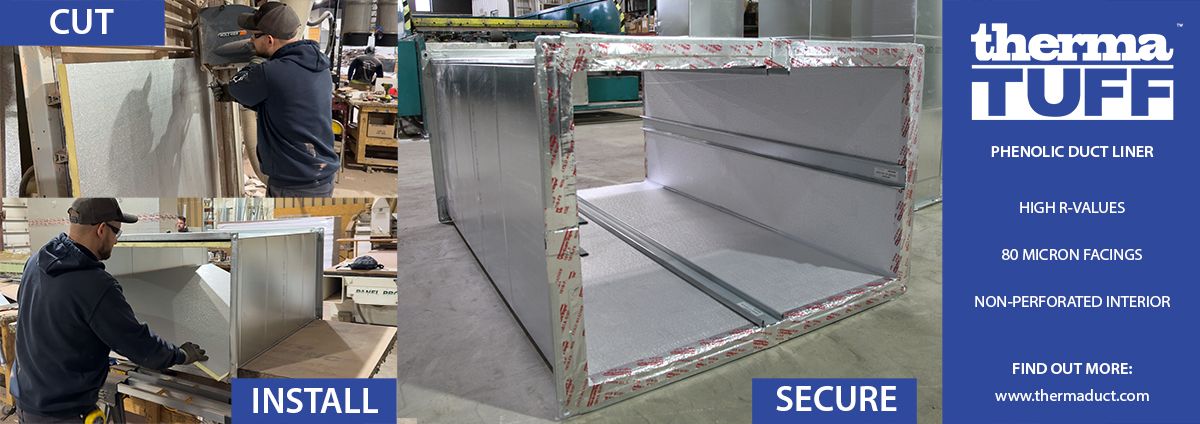
Thermatuff® Phenolic Duct Liner for Data Centers: Clean, Tight, Reliable Air Distribution
Specifications for commercial, healthcare, and industrial projects have been moving toward non-fibrous duct liner, and data centers are no exception. Data centers can't afford liner problems, condensation over equipment, or a schedule that waits on the duct shop. Thermatuff® is a rigid phenolic duct liner that is mechanically retained, with no adhesive to fail and no fibers in the airstream. Paired with Thermaduct® pre-insulated outdoor ductwork on the roof, it gives mechanical engineers and contractors one phenolic system from the rooftop units to the air-cooled space.
Features for data center projects:
Mechanically retained liner with Tuff-lock® clips or Airtruss® reinforcement. No glue, no cure time.
80-micron non-perforated aluminum facing on both sides
Fiber-free closed-cell phenolic core
R-6 for interior lined duct; R-12 and higher for outdoor ductwork
ASTM E84 25/50 and NFPA 90A compliant
Low air leakage connections
Rated for air velocities up to 6,000 fpm
Retention configurations for pressure classes up to 10" w.g. with Airtruss®
The Thermatuff® Difference in Data Centers
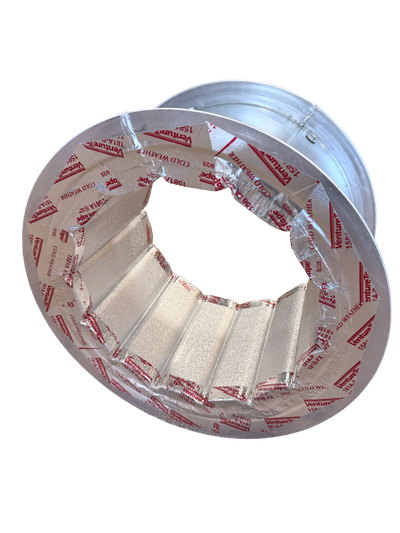
Elastomeric liner has an established track record, but it depends on an adhesive bond to stay in place. That bond relies on careful surface prep and cure time, and adhesive failure is a known issue across the industry. Thermatuff® takes a different approach: a glue-free mechanical system that moves liner retention away from adhesive and toward a defined, repeatable method. Thermaduct introduced Thermatuff® at the 2026 AHR Expo, building on more than a decade of experience with phenolic duct liner. Its rigid panel and smooth, non-perforated facing keep the airstream clean and resist moisture, while lightweight panels move through the shop and onto the job faster.
Advantages of Thermatuff® for Data Center Air Distribution
No Adhesive to Fail
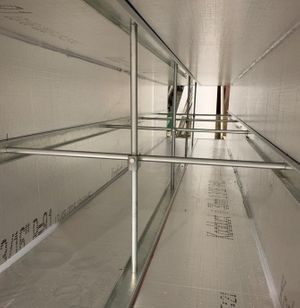
Thermatuff® panels are installed in an abutting layout and held mechanically, with no adhesive bond to depend on. At smaller sizes and lower pressures, Tuff-Lock® clips provide the retention on their own. As duct size, pressure class, or section length increases, Airtruss® adds full-length retention that wraps around the TDC/TDF flange and through the inner surface of the panel, and it can interface with structural ties that pass through the liner.
SMACNA still sets the metal duct construction. Airtruss® adds rigidity by tying the inner and outer layers of the lined assembly together, which helps the duct resist movement from both positive and negative pressure.
Non-Perforated Aluminum Facing
An 80-micron aluminum facing with zero perforations covers both sides of the panel. It resists moisture and gives a smooth surface, with no exposed fibers or open-cell foam.
Built for High Velocity, High Pressure, and Low Leakage
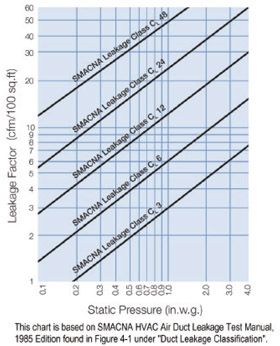
Thermatuff® lined systems are rated for air velocities up to 6,000 fpm, with retention configurations for pressure classes up to 10" w.g. when Airtruss® is used. Tight, low-leakage connections and a closed-cell core help keep conditioned air where it belongs and reduce the risk of condensation on duct surfaces.
Faster Fabrication
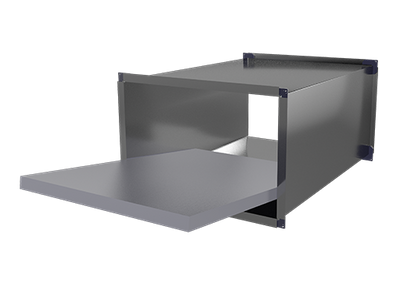
Thermatuff® is faster to fabricate than lining duct with elastomeric insulation. There's no adhesive to apply and no cure time, so the labor in the shop moves from gluing to a defined mechanical process, and crews get more consistent results from one job to the next.
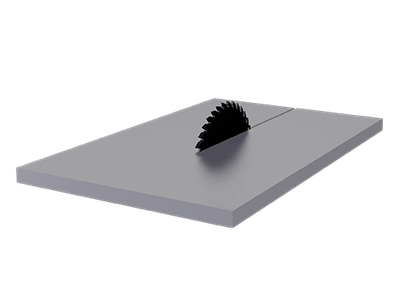
Panels can be cut with specialized hand tools, water jet tables, table saws, or CNC machinery. Some cutting methods create fine dust, so shops should plan for dust collection. Thermatuff® can also be ordered pre-sized to fit directly into the duct, with no cutting at all.

From the Rooftop to the Air-Cooled Space
On data center projects, Thermaduct® pre-insulated outdoor ductwork carries air from rooftop units to each sector of the building, typically at R-12. Inside, Thermatuff®-lined ductwork feeds the air-cooled spaces, typically at R-6. One phenolic system covers both, with one manufacturer and one set of submittals. Learn more about Thermaduct® outdoor ductwork.
Built for Hyperscale Schedules
Thermaduct® works with mechanical contractors and engineers on hyperscale and enterprise data center projects, and we'll work to accommodate hyperscale deadlines. Talk to our headquarters team early in design so the liner and ductwork are specified and scheduled with the rest of the mechanical package.
Specifying Thermatuff® for Your Data Center
Engineers are specifying 1" phenolic liner on data center projects. Submittals, spec sheets, and SDS are available on our literature page. Our headquarters team can help with specification language and pricing. Installers can also take our free online installer training.
Data Center Duct Liner FAQ
Why use phenolic liner instead of elastomeric or fiberglass liner in a data center?
Thermatuff® is mechanically retained, so it doesn't depend on adhesive that can fail. It's fiber-free, and its non-perforated aluminum facing resists moisture and keeps the airstream surface smooth.
Is Thermatuff® code compliant for data center ductwork?
Yes. Thermatuff® is ASTM E84 25/50 and NFPA 90A compliant. Submittals and SDS are available on our literature page.
What R-values are typical on data center projects?
Interior lined duct is typically R-6. Outdoor ductwork is typically R-12 or higher. Panels can be layered for higher R-values.
Can Thermatuff® help with condensation?
Its closed-cell phenolic core, non-perforated facing, and low-leakage connections help reduce the conditions that cause condensation on duct surfaces.
What air velocity and pressure can Thermatuff® handle?
Thermatuff® lined systems are rated for air velocities up to 6,000 fpm. With Airtruss® retention, configurations are available for pressure classes up to 10" w.g.
Does Thermatuff® use any adhesive or tape?
Liner retention is fully mechanical, with no adhesive bond. Finishing steps still apply: UL 181 foil tape at exposed edges keeps the vapor barrier intact at each flange and at Tuff-Lock® penetrations, and Thermatuff® sealant goes on all four corners of the duct and at tie locations.
Can I order Thermatuff® pre-cut?
Yes. Thermatuff® can be ordered in sizes that fit directly into the duct, so shops can skip cutting entirely. Panels can also be cut in the shop with hand tools, water jet, table saw, or CNC equipment.
Is Thermatuff® faster to fabricate than elastomeric liner?
Yes. Mechanical retention removes the adhesive step and cure time, so shops fabricate lined duct faster and more consistently.
Does Thermaduct® make outdoor rooftop ductwork too?
Yes. Thermaduct® pre-insulated outdoor ductwork is built for rooftop conditions with weather-resistant cladding. Many data center projects use both: outdoor ductwork on the roof and Thermatuff®-lined duct inside.
How fast can you support a fast-track schedule?
We'll work to accommodate hyperscale deadlines. Contact our headquarters team early in the project so we can plan with your schedule.
How do I get pricing for a data center project?
Data center inquiries go directly to our headquarters team. Request a quote or call 855-809-6903.
The Thermaduct® family of products are patented systems. For more information, visit www.thermaduct.com/patents.